YOUR SIGNAL CAN’T SERVE WHAT ITS DETECTION CAN’T SEE.
- False calls: Glare, shadows and dusk create calls for vehicles that aren’t there, and side streets get green for no one.
- Missed calls: A broken loop leaves a movement stuck at red. The council hears about it before you do.

- Add-ons: ATSPM, near-miss analytics and timing software each come as a separate license, if they are offered at all.
- Stale plans: Timing runs on counts from years ago, because a new count study needs budget and a consultant.
- Button-only: The controller knows someone is waiting only if they press the button. It never knows they are still crossing.
- One clearance for all: A slow walker, a parent with a stroller and a wheelchair user all get the same seconds.

EVERY VEHICLE. EVERY APPROACH. ALL INCLUDED.
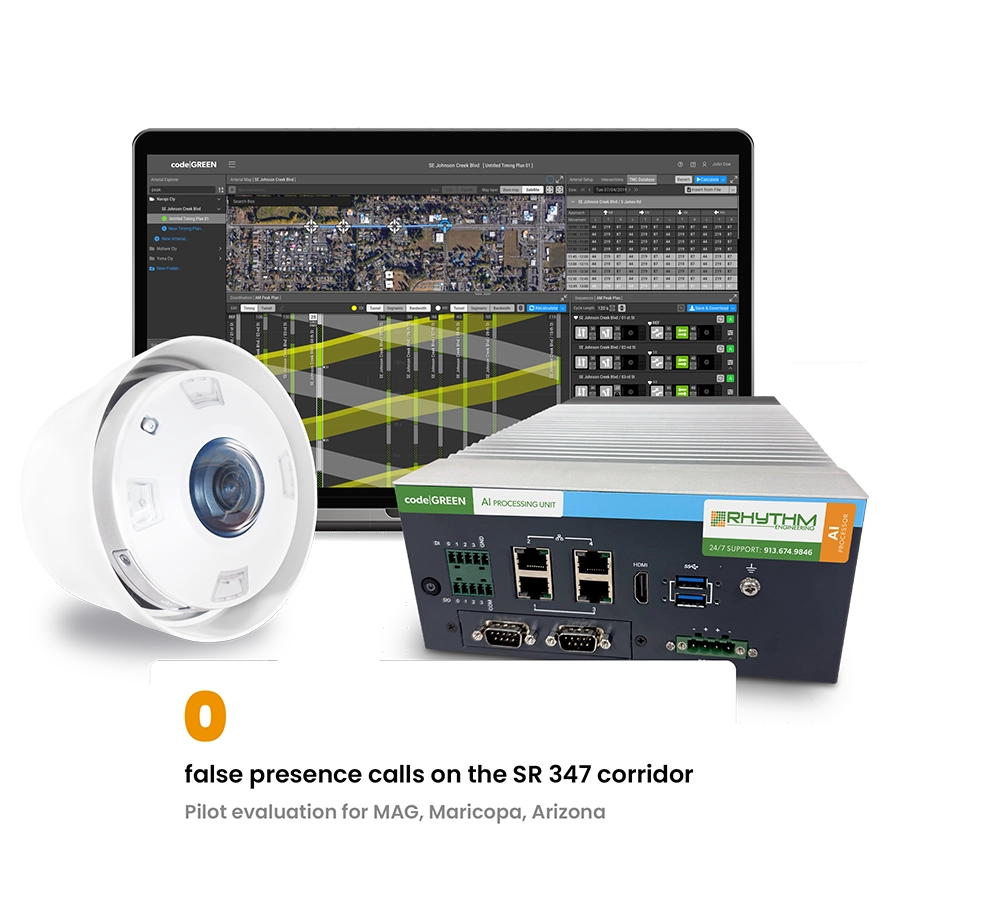
Cyclops replaces loops and legacy video detection with AI that recognizes each vehicle. Here is what comes standard at your intersection.
- Recognized, not guessed: Deep learning, the same class of AI used in self-driving cars, recognizes each vehicle. On SR 347, evaluators found zero false presence calls.
- Zones that fit the road: Free-form zones follow curved lanes and odd geometry, with up to 64 detector outputs per processor. A zone calls only for traffic heading the way you set.
- Fail-safe: If fog, glare or an obstruction blocks a view, its detectors go to max recall until the view clears.

- ATSPM included: Purdue Coordination Diagrams, split failures, arrivals on red and delay come from the same cameras. No separate platform to license.
- True turning movements: Every vehicle is counted lane by lane, all day, every day. No count crew needed.
- Standard format: Events are logged with millisecond timestamps in the standard ATSPM event codes, so your other tools can read them.

- Near misses: Close calls are flagged and mapped, so you know which movement to fix before a crash does.
- Passed on red: Red-light running is logged by approach, so you know which one needs attention first.
- Yours: All data stays on your network. You own it and pay no fees to access it.
- Ready to share: Export CSV, Excel and PDF reports for council, a grant application or your consultant.
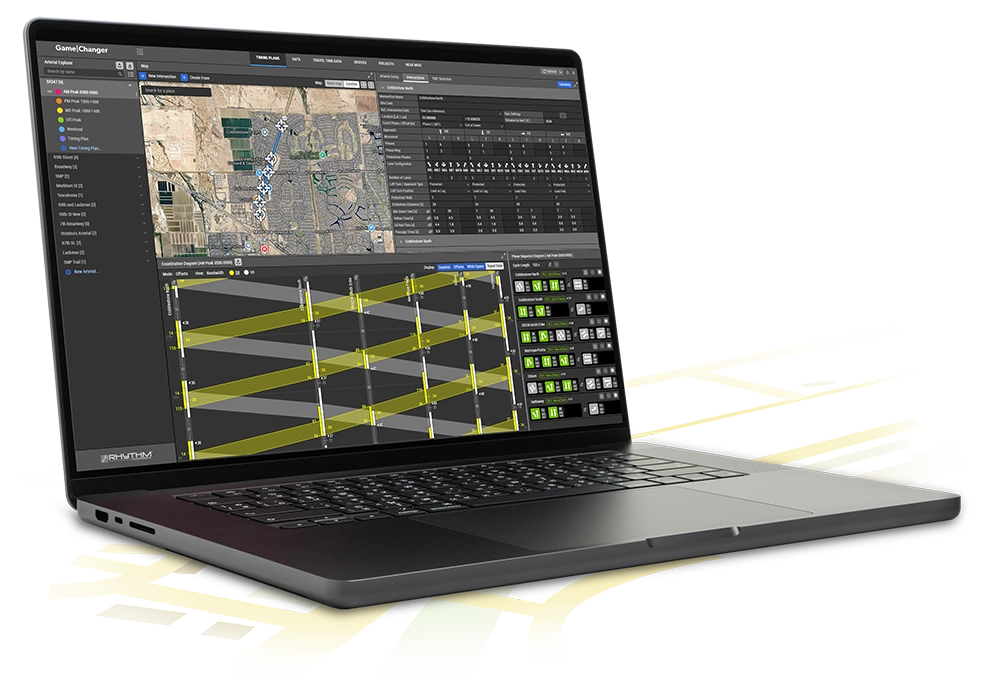
YOUR DETECTION CAMERAS ALSO WRITE YOUR TIMING PLANS.
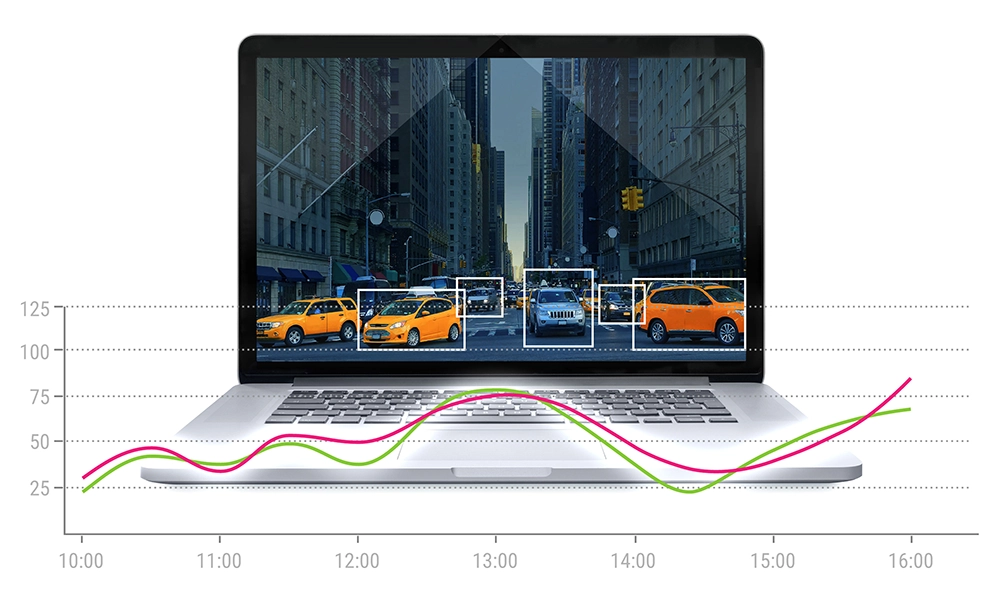
Most detection stops at the call. Cyclops keeps counting, and its built-in optimization engine turns those counts into timing plans in minutes. No extra license.
You get a plan for each day of the week, for special events and for each season. It works with all makes and models of controllers and cabinets, and it keeps your plans current as traffic changes.
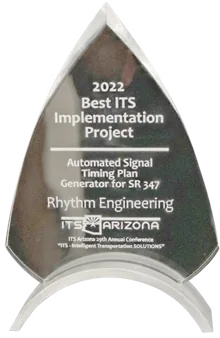
On SR 347 in Maricopa, Arizona, Cyclops timing plans cut wait time 44% and stops 24%. The project won ITS Arizona’s 2022 Best ITS Implementation award.
“If you let CYCLOPS run long enough, it will gather all the data, it will figure out timing plans for you.”
Bruce Dressel, Traffic Engineering Manager, Arizona DOTSTART WITH VEHICLES. ADD PEOPLE. THEN PROTECT THEM.
Every Cyclops system starts with vehicle detection. Add the layers your Vision Zero plan needs, on the same cameras and processor.
detection
- AI vehicle detection on every approach
- ATSPM and passed-on-red reporting
- Near-miss analytics
- Turning movement counts
- Timing plans in minutes
- People and bikes recognized at the curb and in the crosswalk
- Separate calls for pedestrian and bike phases
- Counts by crossing and direction
- Push buttons stay in service
Builds on vehicle detection.
safety
- Crossing held for anyone still in the crosswalk
- Every hold logged with a timestamp
- Time-of-day risk patterns for your safety plan
- Evidence for Vision Zero and SS4A
Builds on pedestrian and bike detection.
SEE EVERY PERSON AND BIKE, NOT JUST CARS.
Add pedestrian and bike detection, and Cyclops recognizes people at the curb and in the crosswalk, along with every bike on the approach.
- Separate calls: Pedestrian zones and vehicle zones each call their own phase.
- Push buttons stay: Existing push buttons and accessible pedestrian signals keep working. Cyclops adds detection and takes nothing away.
- Counted by crossing: Pedestrian and bike counts by crosswalk and direction give your Vision Zero action plan and SS4A application real numbers.
WHEN SOMEONE IS STILL IN THE CROSSWALK, YOUR SIGNAL WAITS FOR THEM.
- Held: Each time someone is still in the crosswalk as clearance ends, Cyclops holds the phase, up to a maximum you set, and logs the event with a timestamp.
- Timed: Time-of-day charts show when risk peaks, such as the half hour after school lets out.
- Ready for council: Every hold is data you can use in a safety audit, a Vision Zero update or an SS4A application.
At a school crossing, Cyclops held the signal for people still in the crosswalk. Most events came in the half hour after dismissal.
Ask for the field study →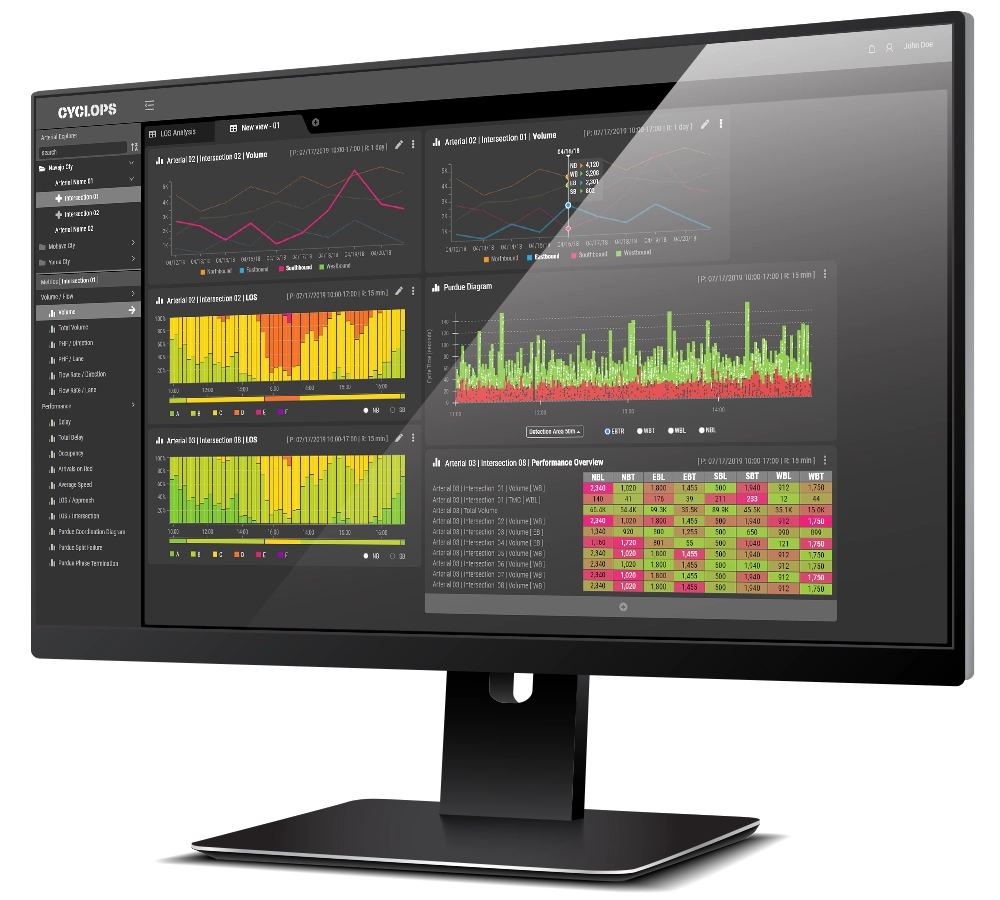
FITS THE CABINET YOU HAVE. RUNS FROM YOUR DESK.
Compatible
Works with Caltrans 170, ATC, ITS and NEMA TS1 and TS2 controllers, in NEMA TS1, TS2, 330x-style and ITS cabinets.

At the edge
All detection runs on the NVIDIA processor in your cabinet. A fault at one intersection never affects another.

Remote
Draw zones, check live views and pull reports in a web browser on your network. No special software.

Upgradable
Already have IP cameras? Cyclops can bring AI detection to the cameras you own.
Hardened
NEMA-rated hardware, built for -40°F to 165°F.

MEASURED BY INDEPENDENT EVALUATORS, NOT BY US.
Vehicle presence
No false presence calls, and counts with no significant difference from manual counts.
SR 347 pilot, MAG, 2023
Less waiting
Lower wait time on SR 347 after Cyclops timing plans went in.
Arizona DOT, MAG and HDR
Fewer stops
Same corridor, same evaluation. Zero motorist complaint calls.
Arizona DOT, MAG and HDR
Pedestrian calls
Pedestrian detection calls and counts at Apache Blvd and College Ave, Tempe, with the pedestrian and bike upgrade.
Rick Engineering for MAG, 2021
Rick Engineering tested 7 pedestrian and bike detection systems for MAG. 4 were deployment-ready. Cyclops was one of them.
On the FDOT Approved Product List for video detection, AI vehicle detection, pedestrian and bike detection, and timing plan intersection control.
TWO WAYS TO SEE YOUR INTERSECTION.
Pick the camera setup that fits your geometry. The processor, the software and everything included stay the same.
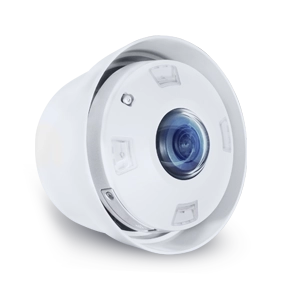
One 9 MP fisheye camera covers every approach of a standard intersection. Fewest parts, one cable and the quickest install.
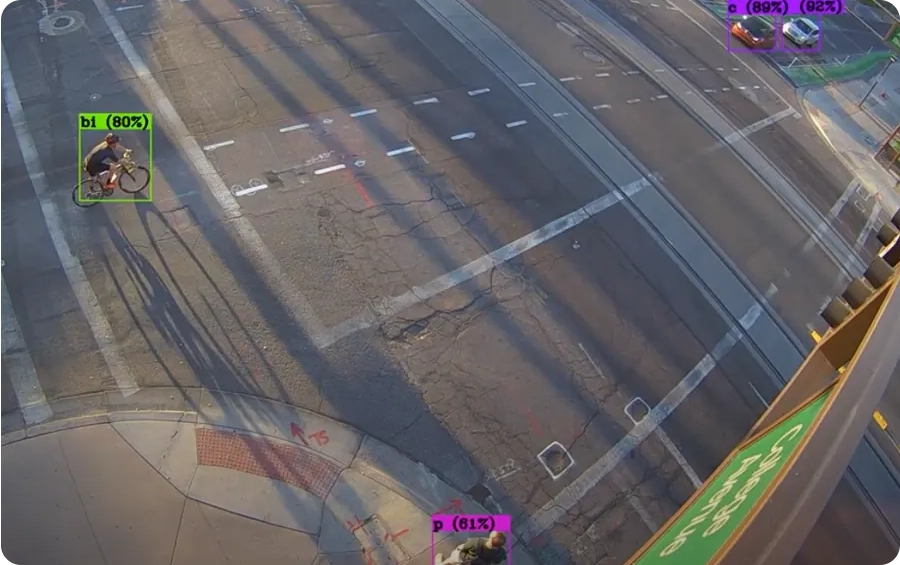
Best for: standard four-leg intersections with a clear view from one pole.
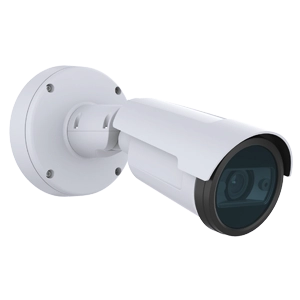
One camera per approach, on your existing poles or mast arms. Remote zoom and focus let each view match its approach.
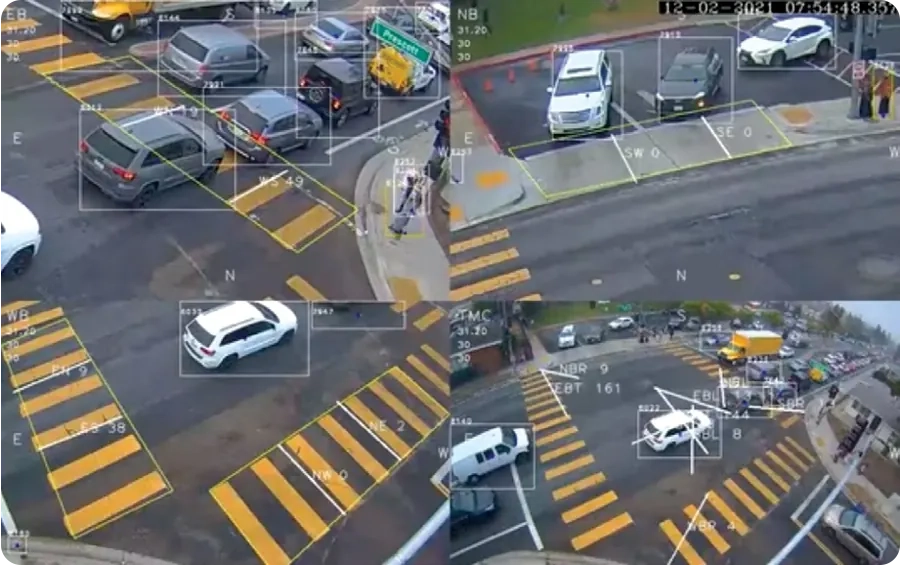
Best for: wide or complex intersections, longer approaches and the most accurate pedestrian detection.
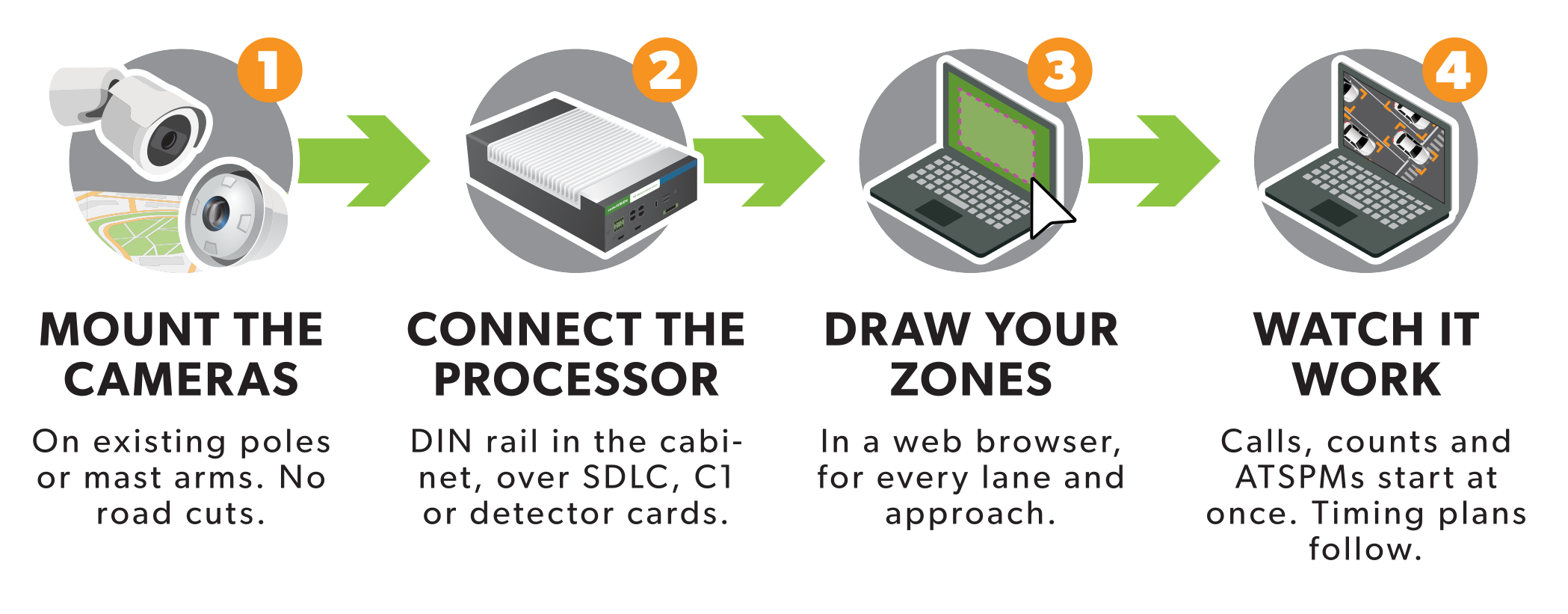
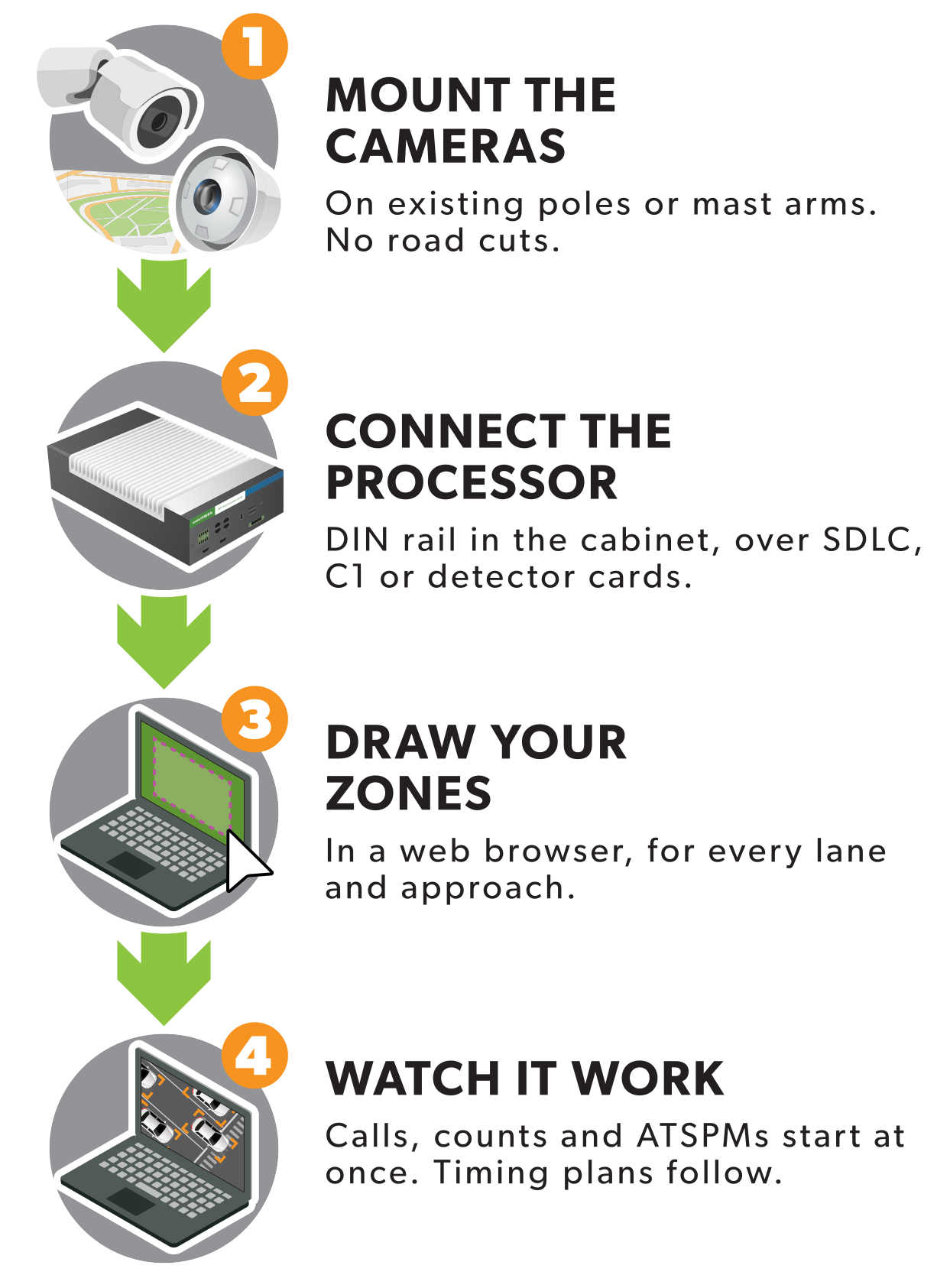
THEN FOUR STEPS TO A WORKING INTERSECTION.
CUSTOMER STORY · PEDESTRIAN SAFETY
How Tempe gives stranded pedestrians time to finish crossing
- At Apache Boulevard and College Avenue, MAG and the City of Tempe wanted safer crossings for people on foot and on bikes. Cyclops watches the crosswalk and extends green time for anyone still crossing.
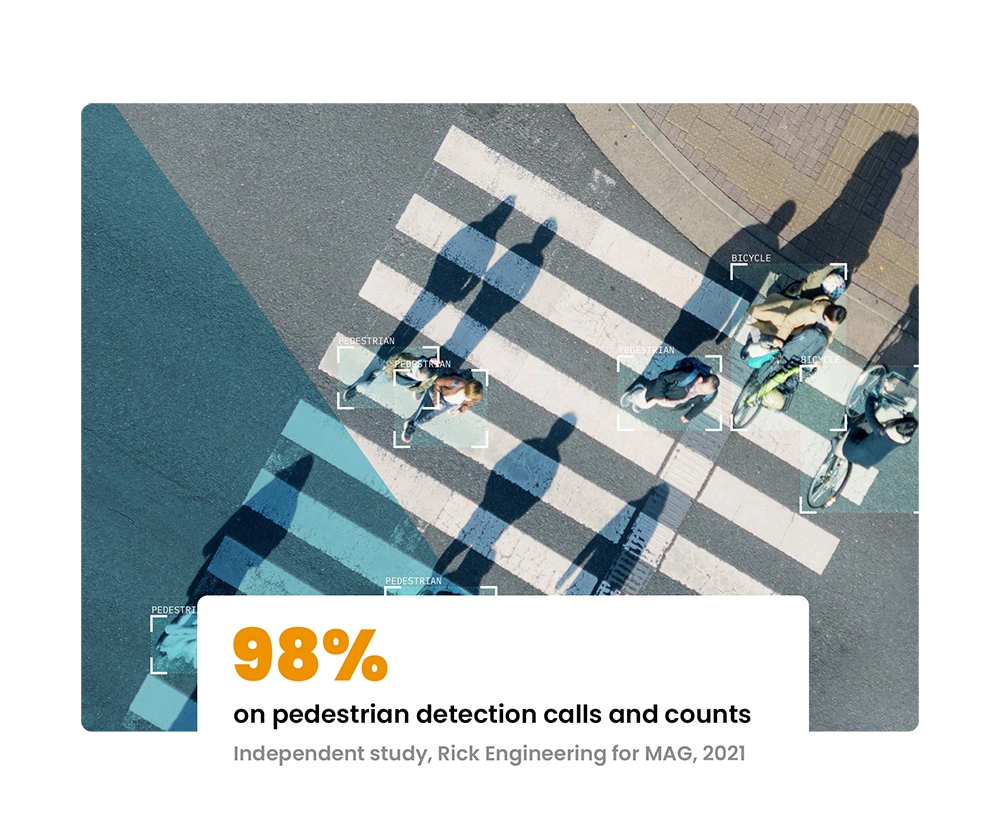
- MAG asked Rick Engineering to test 7 detection systems there, from before sunrise to late evening. Cyclops scored 98% on pedestrian calls and counts and was rated deployment-ready.
Also in service: Caltrans District 6 (15+ intersections, 25+ more specified), Maricopa County DOT (41 intersections), City of Maricopa, City of Little Rock and City of Rolla.

DETECTION, NOT SURVEILLANCE
Cyclops sorts road users by type: cars, trucks, buses, bikes and pedestrians. It does not read license plates or identify people, and it has no enforcement function. Detection runs in your cabinet, and the data stays on your network.

PAY FOR IT WITH SAFETY FUNDING
Pedestrian detection and safety analytics fit Vision Zero and Safe Streets and Roads for All (SS4A) projects. Our funding finder shows which programs match your corridor.
Everyone who steps off the curb should reach the other side.
See what Cyclops would do at one of your intersections. 30 minutes, engineer to engineer.